
Now that I have your attention, let me explain!
It’s not that I find classical music stressful, or that I’m unable to relax when listening to it. I mean, as you likely know or have put together I have nearly two decades of musical training in violin, with a heavy lean towards the style known as Western classical music. I would not have chosen to peruse this instrument at the level I am if I truly found that classical music was stressful.
So, if that’s the case . . . why do I not find classical music relaxing?
The answer: active listening
Active vs. Passive Listening
In order to demonstrate the difference between active and passive listening to music, let me paint two pictures for you.
In the first picture, we have someone listening to a symphony and allowing their ears to focus in on the smallest of details it can sense. Intonation, dynamic phrasing, stylistic interpretation, ensemble balance, how the instruments interact with one another in the music and etc. This individual isn’t only trying to enjoy the music but to understand it. They want to know what they are listening to, how it works, and possibly think about how they would play that piece of music.
This is active listening.
In the second picture, we have someone who is listening to that same symphony, but they may also be doing chores, driving, studying, or sitting in a room having a conversation while catching up with friends. The music is there to support them and they are listening but they aren’t necessarily zeroed in on focusing the details of every melody line, or musical interactions between different instrumental parts. The music here is similar to the background lighting of a room, it’s helping set the tone while not being the focal point of a room.
This is passive listening
Both are valid and valuable ways to listen to music. And honestly? Most people will shift naturally between the two without even realizing it. For example, if the band playing in the background of a restaurant changes song styles suddenly-even if you’re passively listening your brain will notice that change and shift your focus to the music momentarily in order to make sense of it, before returning the music to the background and going back to a passive listening state.
Which is Better?
Objectively? Neither. Active and passive listening serve very different purposes.
However as a musician and educator I am biased towards active listening, as it’s an invaluable skill to learn. It helps build memory, focus and deeper musical understanding. When young musicians learn to listen actively, they also learn how to intentionally observe, interpret and respond, which are three things that translate far beyond music.
As for non-musicians, active listening is still useful for you too! It’s a powerful way to form a richer relationship with music and lets you notice the layers behind what you hear, and gives you an understanding of what the composer is trying to convey, or how music enriches other forms of media. For example, have you ever heard of the 13th century Gregorian chant, Dies Irae? (“Day of Wrath”)
If you’re a fan of classic horror movies, I know you have, even without knowing! This chant is directly quoted in the main theme, and opening scene of The Shining.
If you’re a Star Wars fan, you have because it’s quoted dozens of times throughout the first trilogy, prequels, and other subsequently released Star Wars related media.
In fact the Dies Irae is notable for being the most quoted musical theme in all of history. It often hides in plain sight, where once you know of it’s existence any amount of active listening can point it out during almost any film score, and even other musical compositions or popular songs
Active Listening Student Activity
Now that you know a bit more about active listening, there are some activities you can do in order to practice this skill. Don’t put pressure on yourself to be 100% focused for the entire piece, but work towards challenging the barriers of your ear’s focus, trying to notice at least one new thing each time you listen.
If you’re a teacher, check out this post for a complete step-by-step example activity on active listening to incorporate into your classroom or practice room.
If you’re a student, looking to incorporate active listening into your practice routine, try the activity below.
1. Pick a piece or a song, that doesn’t too far exceed 5 minutes.
If you’ve never done this activity before, a famous or well known symphony, such as the first movement of Beethoven’s 5th is a good option, and if you have a good challenge would be the first movement of a Bach Sonata (timestamp: 1:19-4:50)
2. Listen to the piece without making any judgements
If you slip into passive listening here that’s totally fine. Just let your brain absorb what you’re listening to, and observe without analyzing.
3. Listen to the piece again, but this time, make those judgements.
Take note of anything you find interesting, anything you notice, a particular part you enjoy. Do you hear an instrument better then the other? Can you follow one instrument’s part for the whole piece? How fast is the conductor going? Where does the music get louder vs. softer? Is there any call and response, any rounds, any repeats? Write down any questions that come up during the listening as well.
4. Repeat again tomorrow, and the next day.
Give your brain time to forget what you heard and what you observed, and then come back and try the same activity again tomorrow, and then again the next day-and maybe even the day after that. After each listen compare your notes and see if you noticed anything different than you did the day before. It’s fine if not for the first few times, but be mindful that the challenge is to be listening for things we haven’t noticed before, as that level of deep listening is what’s going to help us.
5. Repeat the activity again, BUT with a different recording
Now that you’ve become familiar with the recording and taken a few days to get to know and really observe the piece, find the same piece but a different recording. For example instead of Perlman’s Bach video, maybe use Hahn’s. This will provide you with a fresh perspective and different interpretation of the piece that allows for you to begin comparing and contrasting.
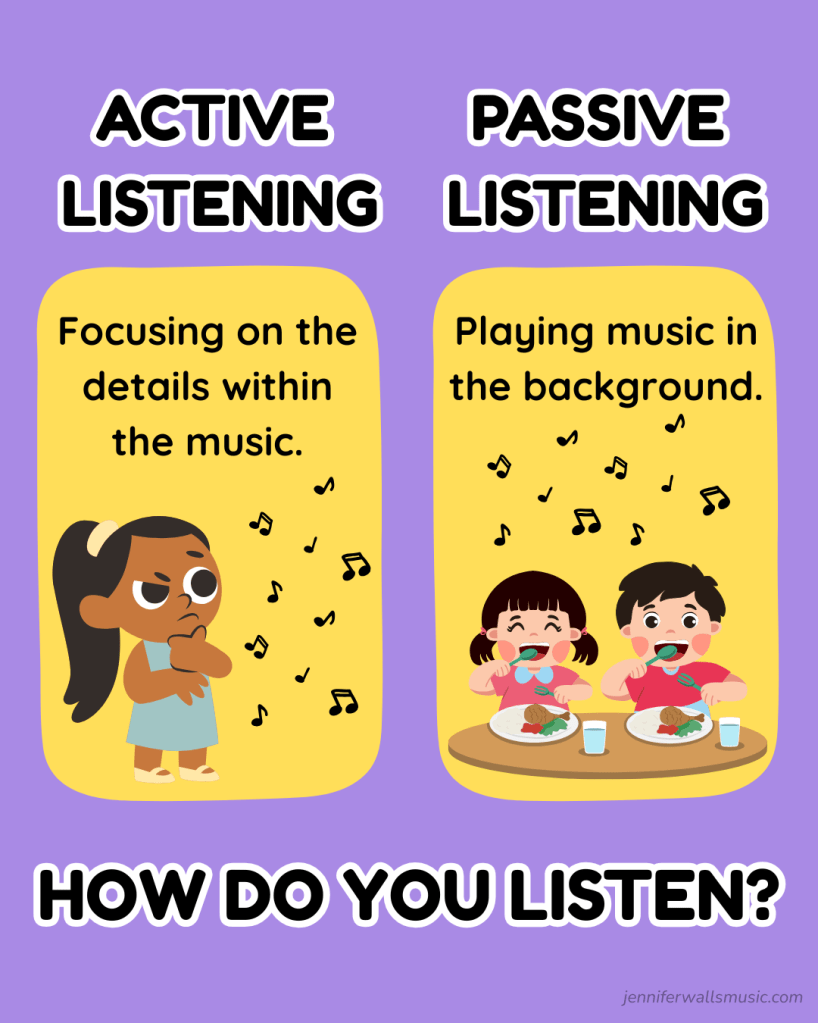
Active listening may not feel “relaxing” but it is deeply rewarding!
Thank you for tuning into this post, I hope you found some enjoyment and gained some knowledge.
Please feel free to use the information graphic to the left as a resource for lesson and/or classroom settings!
 Jennifer E. Walls
Leave a comment