

When we think about what makes a student “successful” in music lessons, we often focus on things like discipline, technical skill, practice habits, performance ability, and other traditional markers of progress in mastering their instrument.
But there’s a deeper question we should be asking. . . are they experiencing joy?
Not just enjoyment, the kind that comes from liking a song or having fun in the moment, but joy as a deeper emotional connection and experience.
In this context, joy reflects a sense of ownership, engagement, and meaning, alongside more familiar feelings like happiness and excitement. It’s not just a helpful support for student success, in my experience, it’s a requirement for sustaining progress, retention, and overall satisfaction in music learning.
More Than Just a Feeling
Joy is one of the most misunderstood elements in education. It often gets brushed aside as a bonus, something nice if there’s time, but not essential. In reality, joy is what makes learning meaningful and lasting.
It’s not just about fun. It’s about emotional safety, connection, curiosity, and creative risk-taking. When students feel that kind of joy, they’re not just participating in a lesson—they’re showing up as themselves.
A 2024 study in Nature Humanities and Social Sciences Communications describes joy as a teaching strategy, not a byproduct. When a student feels joy, they also feel safe enough to explore, ask questions, and push themselves. That emotional space is where deep, lasting learning happens.
For teachers, this means our role goes beyond correcting bow holds or assigning scales. It’s also about creating space where music feels like it belongs to the student. That might look like starting a lesson by asking what they’ve been playing for fun or giving them a few minutes to explore freely before jumping into exercises.
For parents and caregivers, it means celebrating more than just results. Joy might look like your child improvising at home, experimenting with sounds, or replaying a melody just because they love how it feels. These moments are often more powerful than we realize.
The Lesson That Changed Everything
I can say all this with conviction because I didn’t always understand it. In fact, at the beginning of my career, I overlooked joy entirely.
To be fair, my start in teaching wasn’t typical. I was sixteen when I got my first students, still in high school myself. My perspective was shaped by conservatory prep, impending college auditions, and a drive for progress. I thought every student came to music with the same intensity I did.
That assumption led to a moment I’ll never forget.
In May 2016, during a regular lesson, I made a student cry. Not the kind of crying that sometimes happens with young students who get overwhelmed. This was different. I had completely misunderstood why he wanted to learn violin. I was so focused on technical growth that I had sucked all the joy out of the experience for him and, in the process, damaged how he perceived his playing, his musical capabilities, and subsequently, how he viewed himself.
I also cried, except it was after the lesson, in my boss’s office. I was completely devastated by the situation, and had no idea what to do to remedy it.
That’s when everything started to shift. My boss helped me realize something I’d never considered: not every student wants to be the best. Some want to play just because they enjoy the act of making music. That was a foreign concept to me at the time.
He gave me a few tools and ideas. I apologized to the student and made a conscious choice to shift my focus. I started asking a different question:
How can I help this student feel joyful, empowered, and connected to the music?
And something amazing happened. That student started progressing faster than I ever expected. When I stopped prioritizing technical perfection and started nurturing joy, his growth accelerated.
At first, it felt counterintuitive. But it made sense. Joy leads to investment. Investment leads to effort. Effort leads to progress.
That experience reshaped the way I teach, and it continues to guide me every day.
What Joy Looks Like in Successful Lessons
Joy isn’t always obvious. It might not look like constant smiles or high energy. But it shows up in small, meaningful ways:
- A student asking to learn a song they found on their own
- Laughing after a mistake instead of shutting down
- Asking curious questions or improvising freely
- Feeling proud of a phrase they finally got right
- Leaving a lesson energized, not exhausted
For teachers, these are the signals that something deeper is happening. The student isn’t just learning—they’re connecting.
For parents, joy doesn’t just appear, it can be nurtured. It often starts in small moments, like your child humming a tune without being prompted. You can help cultivate that joy by staying curious and engaged. Ask open-ended questions like, “What part of your lesson made you smile today?” or “Was there a moment that felt really fun or exciting to play?” Even casually talking about music they hear throughout the day helps reinforce the idea that music is something to enjoy, not just work on.
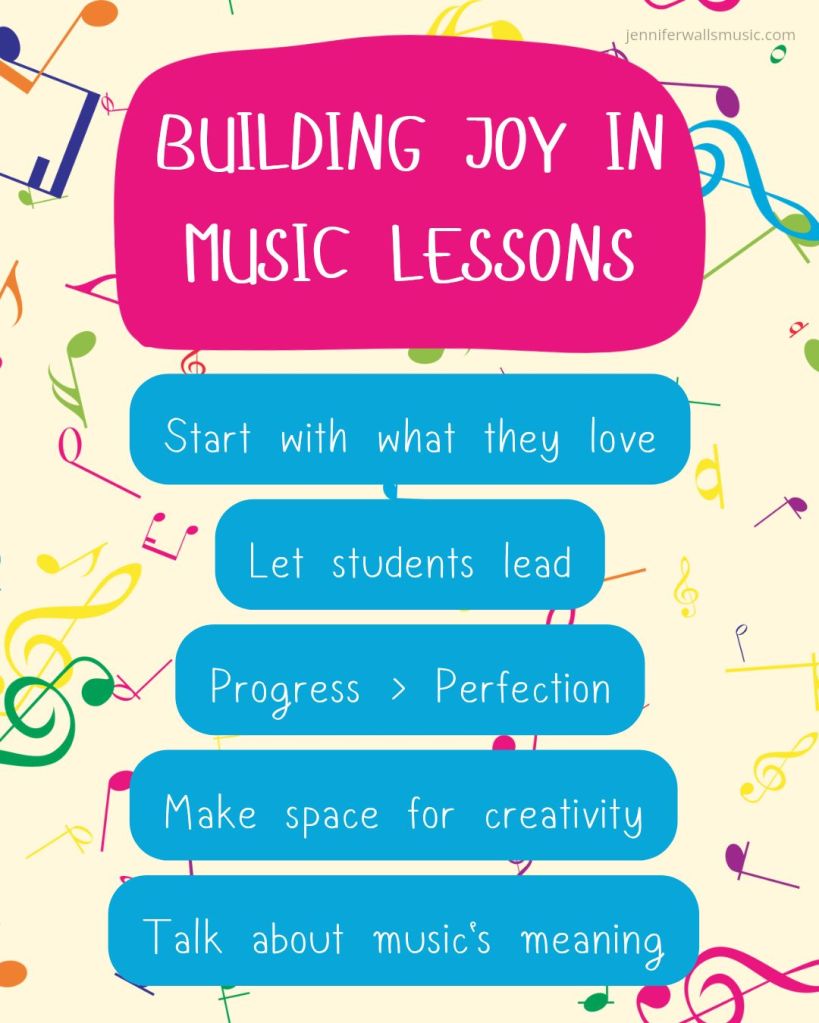
5 Ways to Build Joy and Drive Student Success
Here’s how teachers and parents can work together to make joy a natural part of the music journey:
1. Start with what they love
If your student is obsessed with Taylor Swift, Minecraft themes, or jazz—start there. Musical identity grows from genuine interest. As a teacher, it doesn’t mean throwing out your curriculum—it means building bridges between passion and pedagogy. Parents, encourage their musical curiosity—even if it’s not what you expected.
2. Let them lead
Offer choices during lessons. Let students set short-term goals or choose which piece to focus on. A little autonomy goes a long way in building engagement. Parents can support this by showing trust: let students explore instead of over-scheduling or micromanaging their practice.
3. Celebrate progress > perfection
Praise isn’t about final performances—it’s about growth. Did they try something hard today? Did they show up even when they didn’t feel like it? That’s success. As a teacher, acknowledge these moments. As a parent, celebrate them out loud.
4. Create space for creativity
Make room for improvisation, composition, or just playful exploration. Teachers: this could be a 5-minute jam at the end of a lesson. Parents: give them unstructured time with their instrument—it doesn’t all have to be “productive” to be powerful.
5. Talk about the music’s meaning
Ask what a piece feels like. Share a story about the composer. Talk about what the music says—even if no words are involved. This turns playing into expression, and allows for imaginative play opportunities, thus connecting students more deeply with the process of learning. Parents: start a conversation about how music makes them feel, and what it helps them say.
Redefining Success
Success in music lessons isn’t about perfection or pressure. It is rooted in joy.
Joy fuels a student’s desire to play, to explore, and to keep coming back, even when things get hard. It helps them feel seen, valued, and connected to the music they’re making. A joyful student doesn’t just grow in skill. They grow in confidence, creativity, and emotional expression.
Everything else – motivation, resilience, technical progress, and long-term commitment – starts with joy.
When we center joy in our teaching and support, we don’t just develop skilled musicians. We nurture musicians who love music and carry that joy with them for life.
References/Sources for Deeper Reading:
Reeve, F. J., & Rinehart, S. N. (2011). Student-Centered Instruction and Motivation in High School Band. Music Educators Journal. https://journals.sagepub.com/doi/10.1177/0027432111412829
Hallam, S., Creech, A., & McQueen, H. (2017). Motivation and Engagement in the Context of Music Learning. Journal of Research in Music Education. https://journals.sagepub.com/doi/10.1177/0022429417716921
Allsup, R. E. (2015). Delight and Disquietude: Music Education and the Condition of Joy. Philosophy of Music Education Review. https://journals.sagepub.com/doi/10.1177/1048371314563828
Joy as Pedagogy. Nature Humanities and Social Sciences Communications (2024). https://www.nature.com/articles/s41599-024-03533-0
NAfME Blog: What Does Joy Look and Sound Like in the Music Classroom? https://nafme.org/blog/what-does-joy-look-and-sound-like-in-the-music-classroom
Vivace Music School Blog: Four Reasons for Fostering Joy Through Music in Our Children
https://www.vivacemusicschool.co.uk/post/look-alive-four-reasons-for-fostering-joy-through-music-in-our-children
 Jennifer E. Walls
Leave a comment