
I never thought I’d be a voice teacher.
If you’d asked me a few months ago, I would’ve confidently said, that voice would be one of the only things I’d never touch as an educator. The stakes are too high, with someone’s voice “on the line” so to speak. The teaching voice felt like crossing into not just unfamiliar territory, but territory that I felt wholly unqualified to explore. I was perfectly comfortable in my bubble of orchestral strings and piano, and had no plans to change that lineup.
Life however, did.
With a music degree, years of performance experience, a passion for working with elementary-aged students, and basic understanding of the voices components, I realize now that these many hats make me a perfect candidate for an introductory voice teacher. But it took until I was confronted with a conversation with the director of the music school I’m currently teaching for, that not only challenged my previous viewpoint, but shifted my perspective on how to approach teaching introductory and beginning lessons.
In this conversation, I was reminded that when it comes to young students—especially pre-pubescent ones—voice lessons aren’t about training opera stars, much like how violin lessons aren’t about discovering the next Hilary Hahn.
These introductory lessons are more or less about building healthy habits, exploring sound, and developing the musical and expressive skills that lay the groundwork for whatever comes next.
That gave me the green light I needed to dive in—with care, research, and a little help from my best friend, JSTOR.
What follows is a breakdown of the foundational skills I now prioritize with my younger vocal students. I’m in no way claiming to be a vocal pedagogy expert. In fact I’d say for much of the post I was actively trying to convince you that I wasn’t a vocal pedagogy expert. However, I do see a benefit in sharing what I’ve learned, what’s working in my teaching, and what the research has to say about these approaches.
1. Breath Awareness > Breath Control
We’re not trying to control breath—we’re trying to understand it.
That starts by simply noticing: what does it feel like to take in air? How fast is it moving out? Where do we feel tension? Once students become aware of their own breath, we can begin to shape it—but without the pressure of “getting it right.”
Try this: Have students blow bubbles with a straw or make a “sizzle” (hissing) sound to stretch their exhale. Make it fun—challenge them to go longer each time.
Why it matters: A classic study in the Journal of Research in Music Education showed that breath-awareness exercises improved vocal range, intensity, and pitch accuracy in elementary-aged children.
2. Prioritize Posture
Before we sing, we set the body.
That doesn’t mean “stand up straight” in a stiff, shoulders-back kind of way. It means balance, flexibility, and awareness. I usually walk students through a check-in: feet hip-width apart, shoulders stacked gently over the hips, soft knees, relaxed arms. From there, we just breathe.
Younger students? I use the puppet-on-a-string analogy. “If I gently lifted you up by a string on your head, could I?” It helps them stay upright without locking up.
Try this: Let students “puppet” you first! Then reverse roles. Add music and make it silly—they’ll remember it better.
Why it matters: According to an article in the Journal of Singing, natural alignment supports vocal efficiency and reduces unnecessary muscle tension—especially around the shoulders and neck.
3. Explore Voice Placements
This is one of the most important—and honestly, most fun—skills to explore at this age.
Children’s voices naturally lean toward head voice, but it’s common for students to sing from their speaking voice or try to mimic chest-heavy pop styles. So we make head voice discovery playful and pressure-free.
Try this: Sirens, owl hoots, ghost sounds, or “whooo–ooo” slides. The goal is exploration, not perfection.
Why it matters: A 2023 study in Update: Applications of Research in Music Education found that students with regular head voice exploration improved their range and pitch accuracy over time.
4. Focus on Aural Skills
Not every child is a natural pitch-matcher right away—and that’s okay.
The key is consistency and creativity. I use echo singing, solfege hand signs, call-and-response games, and pitch matching with simple instruments like keyboards or glockenspiels. Some students really benefit from seeing the pitch visually as well as hearing it.
Try this: Use echo games with short melodic phrases, and let them “trick” you by making up a pattern for you to echo too.
Why it matters: A study in Frontiers in Psychology found that children in daily pitch training programs showed stronger auditory processing and pitch-matching accuracy than peers with more general music exposure.
5. Sing With a Story!
Singing is storytelling. And kids already know how to tell stories with their voices.
Instead of “fixing” diction, we lean into character work. Sing it like a pirate. Try it like a robot. How would a witch sing it? How about a sleepy bear? Once they’ve explored the extremes, we pull it back to something expressive and clear—but still fun.
Try this: Choose a silly character for each verse of a song. Rotate through them, then return to a “natural” version and reflect on what changed.
Why it matters: Dramatic play paired with vocal exercises has been shown to improve clarity and student engagement—especially in younger singers.
6. Confidence Comes First
If you remember nothing else from this post, remember this: confidence before competence.
I’d rather a student leave a lesson grinning and proud than singing perfectly. We can always build technique, but only if the student feels safe, seen, and supported. That means celebrating their sound—even the tentative ones.
Try this: Let them perform their favorite song for an imaginary audience. Set up stuffed animals, turn off the lights, give them a hairbrush mic, and cheer like you’re front row at their concert.
Why it matters: A thesis from Liberty University found that game-based voice instruction improved student confidence and retention in early vocal learners.
Final Thoughts
So yeah… I guess I teach voice now.
And if you’re someone with a strong musical foundation, a love for kids, and a willingness to learn alongside your students—you probably can too.
All you need to help a child discover their voice is care, curiosity, patience and a commitment to healthy and joyful exploration!
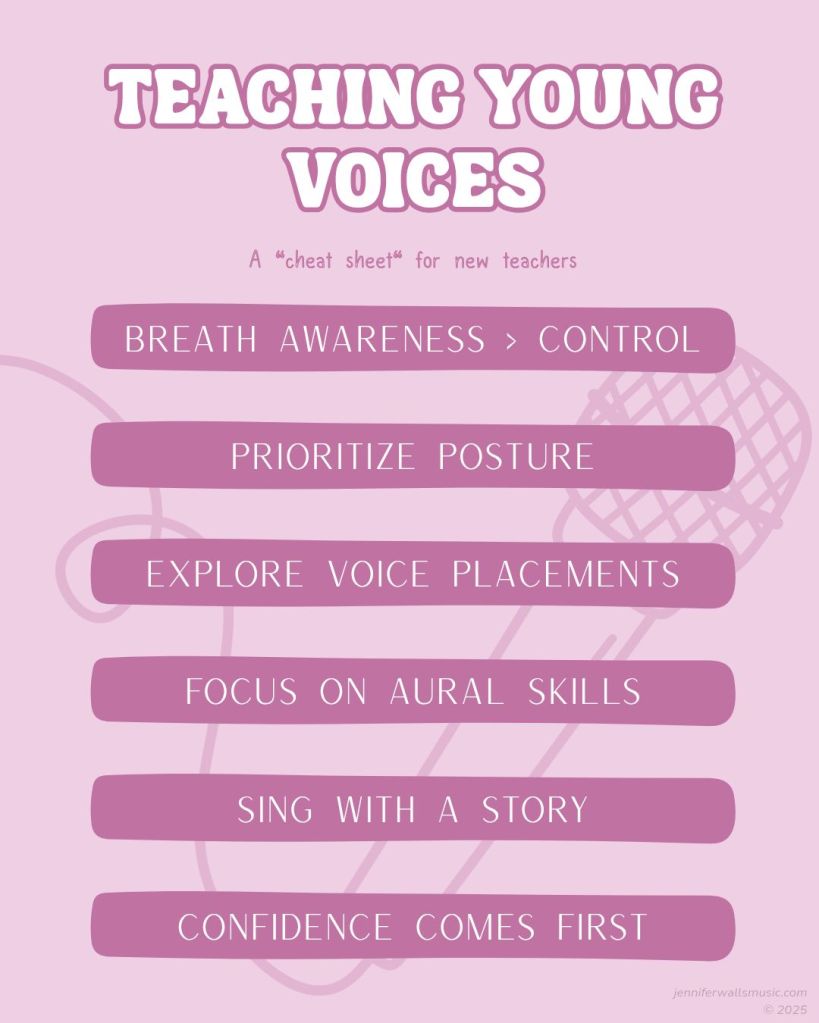
I hope you enjoyed this post, please see below for links to the resources mentioned in the section above, and an informational graphic that summarizes the strategies above!
Resources
- The Effects of Breath-Control Training on Singing Ability in Children
- The Child’s Voice: A Closer Look at Pedagogy and Science
- Vocal Modeling: A Review of Literature
- Pitch Discrimination and Auditory Sequencing in Children With and Without Musical Training
- Teaching Children to Sing: An Eight-Week Study (Graduate Thesis)
 Jennifer E. Walls
Leave a comment