

As I’ve completed my master’s degree in Organizational Leadership, I’ve begun to really deeply think about how to utilize this degree in my current career path as a music educator. After all, I did enroll in the program during an attempted career pivot, and never intended or imagined I would have the opportunity to utilize it in the way I have been able to.
I had the privilege of attending Johns Hopkins University for this program. With the amount of rigor within the coursework that these concepts and frameworks were taught to us within, we were challenged to directly relate them to our own fields, regardless of the context and field they were introduced to us in.
Though at the time of this relation, applying certain frameworks felt like throwing spaghetti at a wall, and hoping something sticks, as I continued through the program it became more and more clear there are multiple ways I can utilize these ideas to to help not only educate my students better in music, but give them tools that they can apply within other disciplines and ventures they may find themselves on later in life. Afterall, these frameworks are the foundational ideas for more generalized principles relating to business and organizational management as a whole, and are able to be applied in every professional discipline to some level.
Why would the discipline of teaching music be any different?
That being said, the first framework I’m going to share today is the SMART framework.
What is SMART?
The SMART framework is a framework that is commonly used to define and establish criteria for goal setting and organizational and/or project objectives. Basically, in order to set a goal, or establish whether a goal is worth setting, the goal must be . ..
Specific
Goals should be well-defined and clear, with no room for ambiguity
Measurable
Goals should have specific performance metrics that all for the measurement of progress towards goal accomplishment.
Achievable
Goals should be attainable and not impossible to reach. The scope of the goal should be within the scope of ability for those who are achieving it.
Relevant
Goals should be aligned with bigger picture and contribute to attaining overall objectives
Time-Bound
Goals should have a clearly defined timeline, including a start date and a target date, in order to create a sense of urgency to motivate goal achievement.
SMART Adaption for Musical Practice
Now that we have a baseline definition for what the SMART framework is, and what it means for a goal to be Smart, Measurable, Achievable, Relevant and Time-bound, let’s synthesize it with pedagogical practice recommendations to create a template for practical application in the music classroom.
Specific
Define exactly what skill or part of the music the student needs to improve
Measurable
Ensure that progress can be tracked with something tangible that can be observed or counted.
Achievable
Make sure that the task or goal being set is within the scope of the student’s current skillset.
Relevant
How does this goal align with the larger picture of this student’s education? What goal, piece, or pedagogical concept can this goal be tied to, and how is it tied to it?
Time-bound
Set a deadline for this goal to be achieved, and make sure this timeline also follows the “SMAR” portion of the framework. Given a specific time, that is measured by however many weeks or months, is achievable given the scope of the student’s current skill set and practice capacity, and is relevant to the general skill progression timeline and trajectory the student is on.
As helpful as this larger definition and outline is, here’s a trimmed down version that can be used for quick reference.
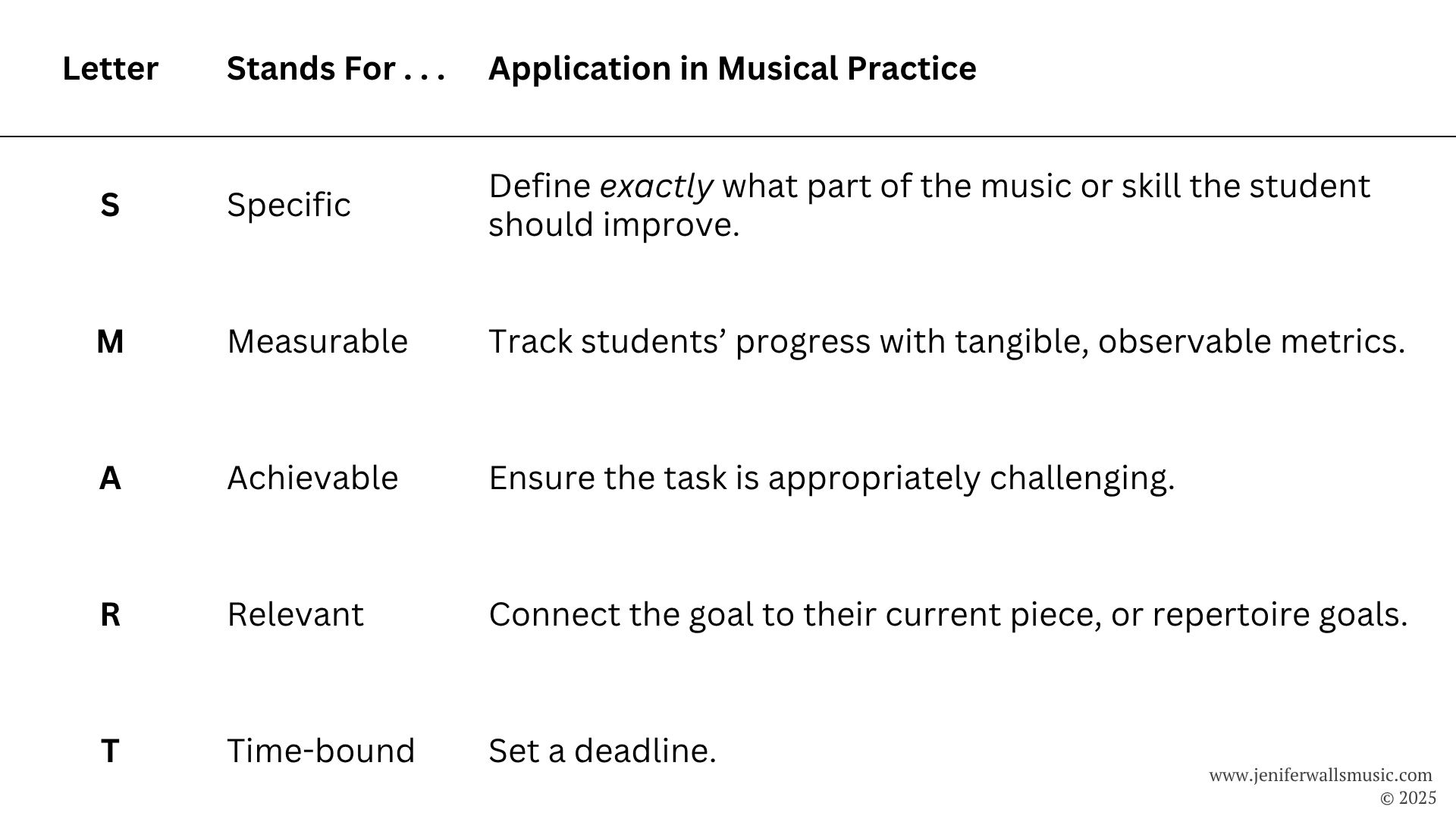
How to Set SMART Practice Goals
Let’s walk through a way that we can turn a vague practice goal into a SMART one.
Starting Practice Goal: Practice your piece.
Upon first glance, this seems to be a standard, OK goal. It’s broad, which allows the student to interpret what they need to practice and can help avoid a student feeling creatively uninspired to practice. However, as practical as this goal may be, there’s something to be said about how it’s vaguity leaves more room for a student to feel too overwhelmed with exactly the endless possibilities of what they could practice, or their inability to think of what exactly they could practice, and thus, we end up with the same outcome of no student practice.
As a way to try and overcome this, let’s try to incorporate the SMART framework, and think about the ways this goal could be adjusted to be SMART.
Let’s start with the are multiple ways why it is not SMART, and therefore would need some adjusting. For example . . .
- Not specific about what parts of the piece specifically need practice.
- It doesn’t give the student any way to measure if they’ve practiced enough, or practiced correctly. How do you know when they’re done?
- The task of an entire piece may be too large, especially for beginners, and assume the student has the stamina, skill and clarity to work on the entire musical piece at once.
- While it might be relevant to the general goal of a student’s completion of that piece.
- There’s no timeline to when a student should have this completed by, and a lack of urgency to achieve and complete the goal.
So let’s go through our SMART table, above and reflect on this goal to be SMART-er.
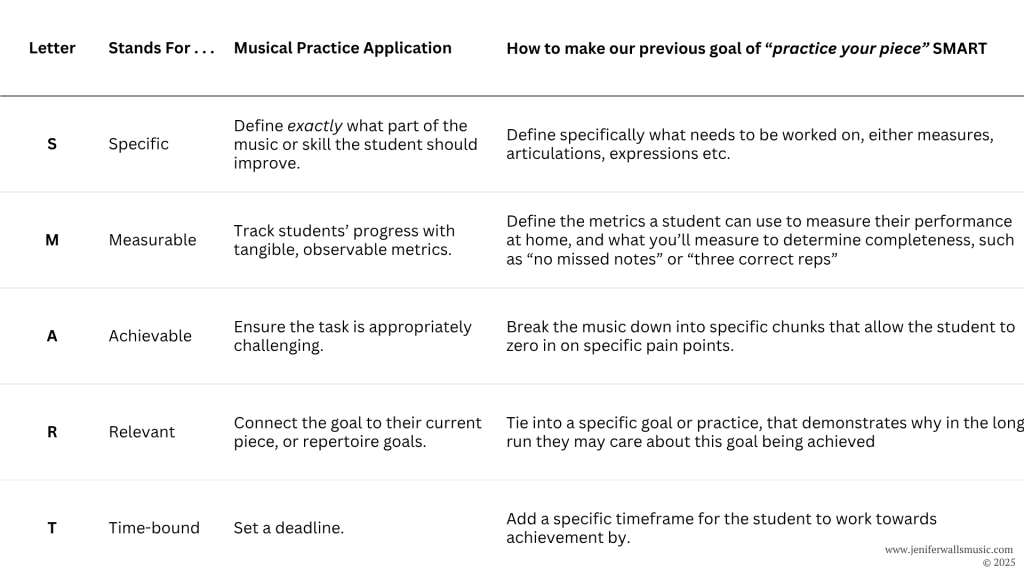
Now that we’ve filled in that table, and recognized what could be improved upon, let’s see our new practice goal that aligns with SMART principles.
SMART Practice Goal: Practice measures 9-16 slowly, at 60 bpm, with correct articulation (staccato), three times in a row by our next lesson on Thursday.
Making Student Practice SMART
Whether you’re a student, a parent, or a teacher reading this article, I hope that you use the information above to help challenge yourself, your students, or your children to make SMART goals for their practice. If you try this at home or in your studio, be sure to leave a comment or reply below and tell me how it went, or any questions you may have about this concept.
Be sure to check out below this post for 3 Free PDF’s for educators including: a classroom poster (color or b&w), and one page “Teacher Quick Guide” to help guide your students, or your own, SMART practice.
Thanks for reading, and I’ll see you for the next post!
Downloads
 Jennifer E. Walls
Leave a comment