
On this page you’ll get a good look at some of the musical groups, projects and presentations I’ve had the pleasure of being apart of in both the present and past!

Holler & Crow
Holler & Crow specializes in whimsical folk fusion magic: music that makes listeners of all ages feel both transported and right at home. Audiences are treated to familiar and cherished traditional folk songs, humorous banter and delightful historical insights at every performance.
Booking and Inquiries:
Click here to be redirected to Holler & Crow’s Booking Webpage
The Mourning Belles
The Mourning Belles is an Asheville-based country trio playing original murder ballads, laments, and lonesome honky-tonk numbers composed by vocalist Alma Hartley. Rounding out the group are Jonathan Watterson on guitar and Jenny Walls on fiddle, who also lend their voices to the haunting harmonies that characterize the band’s unique sound.
Booking and Inquiries:
themourningbellesband@gmail.com

The Jenny Jons
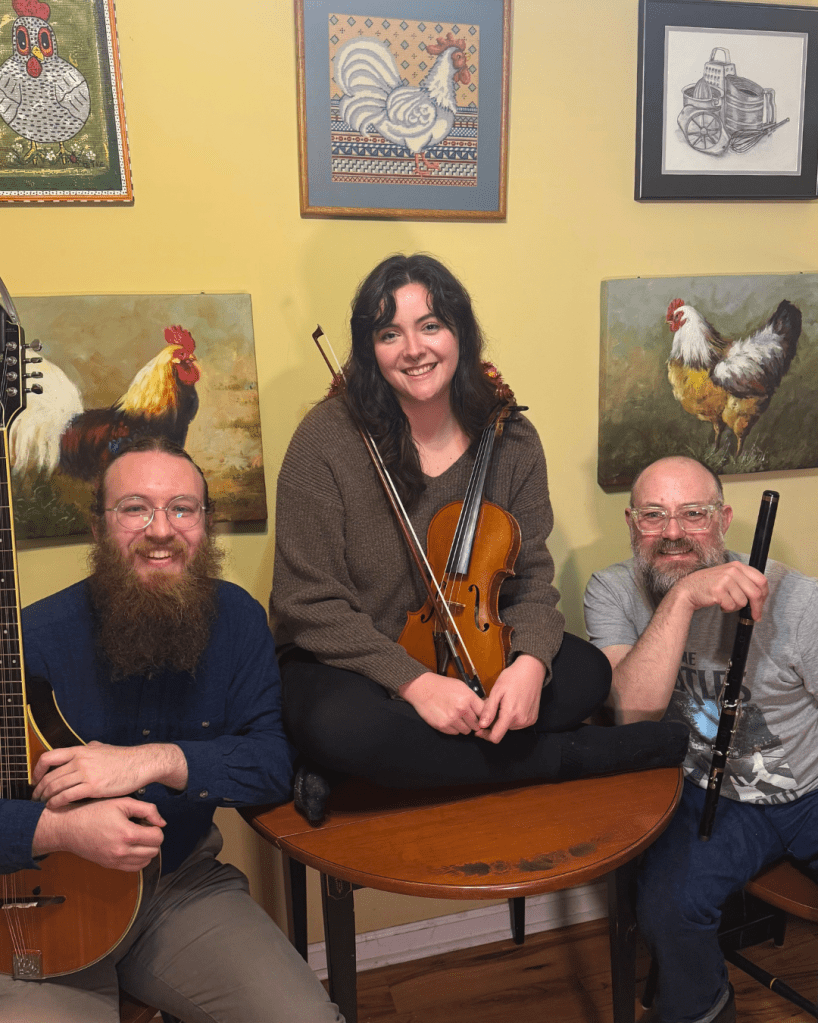
The Jenny Jons, formed in 2024, is an eclectic folk trio consisting of multi-instrumentalists Jenny Walls, Jon Snead, and Jonathan Watterson. All trained classically, but inspired and driven by their shared love of traditional folk music, these three and their collective ability to successfully reimagine songs from nearly any genre, brings to the stage a unique sound and experience, suitable for listeners of all kinds. Whether looking for traditional Irish music, contradance music, American folk music, reimagined video game and movie music, or anything in between, their sound is sure to bring stomp to your feet and a smile to your face.
Booking and Inquiries:
thejennyjonsband@gmail.com
Music Presentations
The Psychic Red: Predicting Taylor Swift’s Rebranding
Taylor Swift broke into the music industry as a country artist in 2006, with her self-titled debut album. In the years following, her music underwent a seemingly natural progression from country to pop, as did her personal brand and media persona. Reputation (2017) is where we did see this rebrand completed. In this paper, I will explore how the musical and lyrical themes in her previous album, Red (2012), not only begins this transition of her musical style, but predicts some of the drastic changes that we see during Reputation in her media persona and personal brand.
Recorded presentation by Jennifer E. Walls for the research project The Psychic Red: Predicting Taylor Swift’s Rebranding, for the course MUSC 340 Advanced Topics in Music Theory: Value, Popularity, and Taste under the direction of Dr. Christine Boone.
Music used within this academic presentation is defined under fair use by Section 107 of US copyright law as outlined: “Notwithstanding the provisions of sections 106 and 106A, the fair use of a copyrighted work, including such use by reproduction in copies or phonorecords or by any other means specified by that section, for purposes such as criticism, comment, news reporting, teaching (including multiple copies for classroom use), scholarship, or research, is not an infringement of copyright.”
The Circle of Bonn: Examining Beethoven’s Relinquishment and Return to Classical Aesthetics Using Sonata Form
Ludwig van Beethoven’s creative, expressive use of Sonata-Allegro form has been traditionally cast as unique, visionary, and heroic. In this paper, I will explore how Beethoven interacted with and influenced sonata form in historical, biographical, and musical contexts. I present a historical and biographical context for the composer and aesthetic consideration of the role of the form in Beethoven’s musical expression. His utilization, throughout his compositional life, of the aesthetic frameworks collectively known as “Sonata-Allegro form”, is a specific way of describing Beethoven’s aesthetic biography. His early compositions comprise formal aesthetic experiments in the early years of his career in Bonn and Vienna. But they also mark the relinquishments of traditionally classical compositional ideology, especially during the latter years of his career. This personal transition served as a creative apex for the man, but also as a more socially relevant door-opening for others’ aesthetic experimentation. I also propose further research opportunities in this direction.
Recorded presentation by Jennifer E. Walls for the research project The Circle of Bonn: Examining Beethoven’s Relinquishment and Return to Classical Aesthetics Using Sonata Form for the course MUSC 499: Independent Undergraduate Research in Music. This project was advised by Dr. Jonathan “Toby” King.
Music used within this academic presentation is defined under fair use by Section 107 of US copyright law as outlined: “Notwithstanding the provisions of sections 106 and 106A, the fair use of a copyrighted work, including such use by reproduction in copies or phonorecords or by any other means specified by that section, for purposes such as criticism, comment, news reporting, teaching (including multiple copies for classroom use), scholarship, or research, is not an infringement of copyright.”
“Quartet Satz”: Intertextualization of Minimalism With Hegemonic Traditions
Philip Glass’s “Quartet Satz” is commonly understood as an example of minimalist western classical music, specifically within the western string quartet genre. In many ways, “Quartet Satz” is a great example of a work in the overarching genre of minimalist string quartet music, but on the other hand, “Quartet Satz” exists outside of this musical genre and begins to overlap with other genres of more traditional classical string quartet music. The western classical string quartet genre is very socially constricted to the voices that exist within the genre itself and is not commonly referred to by the annotative voices that would commonly be found within more mainstream musical genres. My analysis of three specific moments within the score of this piece demonstrates that though the textural sound is very typical of minimalism, there is a notable shift into more traditional string quartet techniques. These moments within the score, though claiming to be minimalist and mono-textual, are in fact used intertextually multiple times. Calling “Quartet Satz” a proper example of the greater western classical string quartet genre is actually breaking what is perceived as traditional western string quartet music and helping dismantle the hegemonic environment that many western classical string quartet players experience while growing up within the genre.
Recorded presentation by Jennifer E. Walls for the research project “Quartet Satz”: Intertextualization of Minimalism With Hegemonic Traditions for the course MUSC 368: Ethnomusicology 2 under the direction of Dr. Jonathan “Toby” King Music
Music used within this academic presentation is defined under fair use by Section 107 of US copyright law as outlined: “Notwithstanding the provisions of sections 106 and 106A, the fair use of a copyrighted work, including such use by reproduction in copies or phonorecords or by any other means specified by that section, for purposes such as criticism, comment, news reporting, teaching (including multiple copies for classroom use), scholarship, or research, is not an infringement of copyright.”
 Jennifer E. Walls